
📖 Method of simulated moments (MSM) for model estimation#
⏱ | words
Next step after solver and simulator are debugged#
Estimate model parameters from simulated data?
study the implications of theoretical assumptions of various models and theories
run numerical simulations of optimal decisions and policies (for particular values or ranges of values of model parameters)
But the ultimate goal is to match the model to the actually observed data, and:
quantify of the effects of various parts of the theoretical setup
perform counterfactual experiments simulating the behavior of the decision maker in hypothetical policy regimes
support or falsify theoretical results by examining their fit to the observed data
Estimation vs. calibration#
What is the difference? Sometimes the terms are used interchangeably
Standard errors of estimates (measure of variability of the estimation results)
Study of identification (to make sure that only a single parameter values can maximize the statistical criterion and explain the data)
Calibration exercises often skip these steps, even if employing algorithmic search of best parameters to fit the model to the data.
Applications of estimation sometimes estimate only a subset of parameters, treating other as fixed, similar to calibration with parameter values from the literature.
Workflow of structural estimation#
Theoretical model development (what is of interest?)
Practical specification/implementation issues
Solving the model (method + implementation in the code)
Understanding how the model works
Estimation: running the statistical procedure
Validation (assessing in-sample and out-of-sample performance)
Policy experiments, counterfactual simulations
Example
Stochastic consumption-savings model
solver to compute the optimal policy function for given parameter values
simulator to simulate data for given parameter values (and model solution)
Need:
estimation procedure to find the “best” parameter values to fit the model to the observed data
counterfactual simulation program to use the estimated model for policy experiments
Understanding how the model works#
Solve the model for a set of parameter values
Simulated data from the model
Does it make (economic) sense?
Repeat (many-many times)
may take a lot of time to convince yourself that the code does not have bugs
unexpected/surprising results still appear? Making research progress!
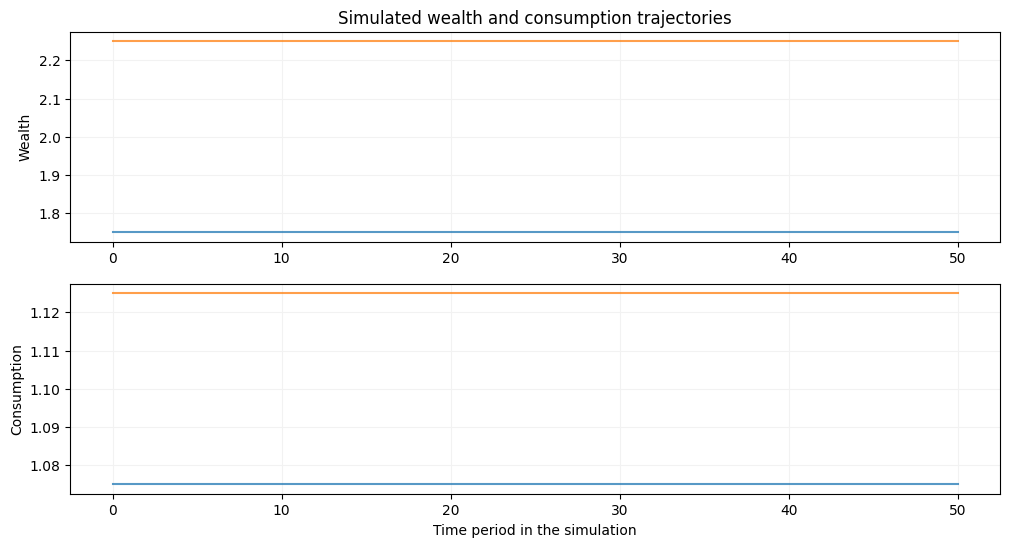
# deterministic model with βR=1 and y=1
m = deaton(beta=0.9,R=1/0.9,ngrid=100,nchgrid=250,sigma=1e-10,nquad=2)
m.solve_egm(tol=1e-10)
init_wealth, T = [1.75,2.25], 50
m.simulator(init_wealth=init_wealth,T=T,seed=2020)
plt.show()
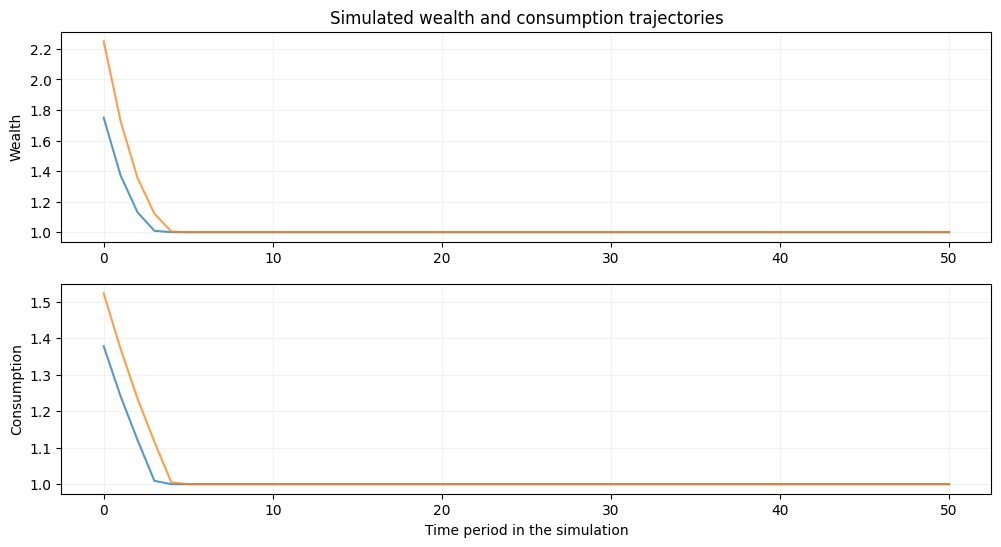
# deterministic model with R=1 and y=1
m = deaton(beta=0.9,R=1.0,ngrid=100,nchgrid=250,sigma=1e-10,nquad=2)
m.solve_egm(tol=1e-10)
init_wealth, T = [1.75,2.25], 50
m.simulator(init_wealth=init_wealth,T=T,seed=2020)
plt.show()
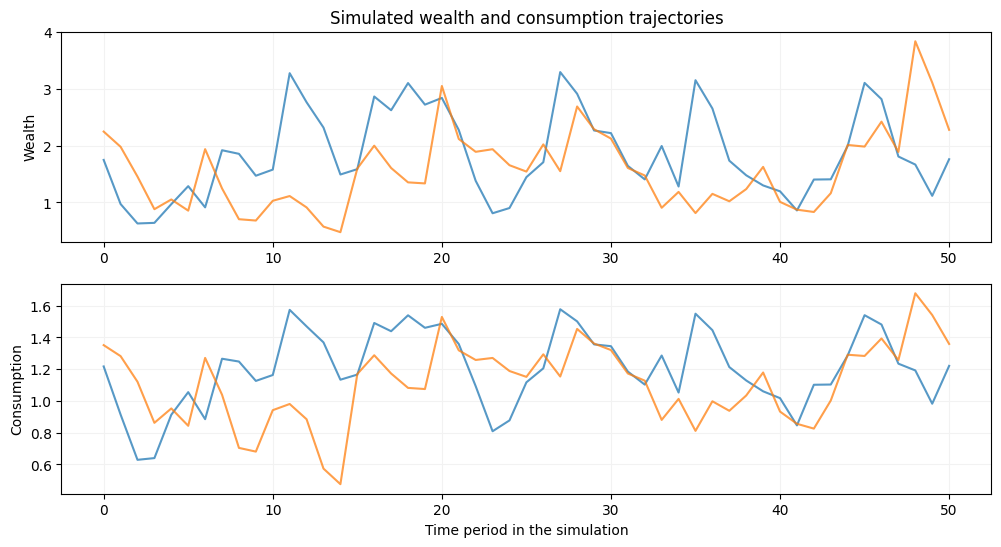
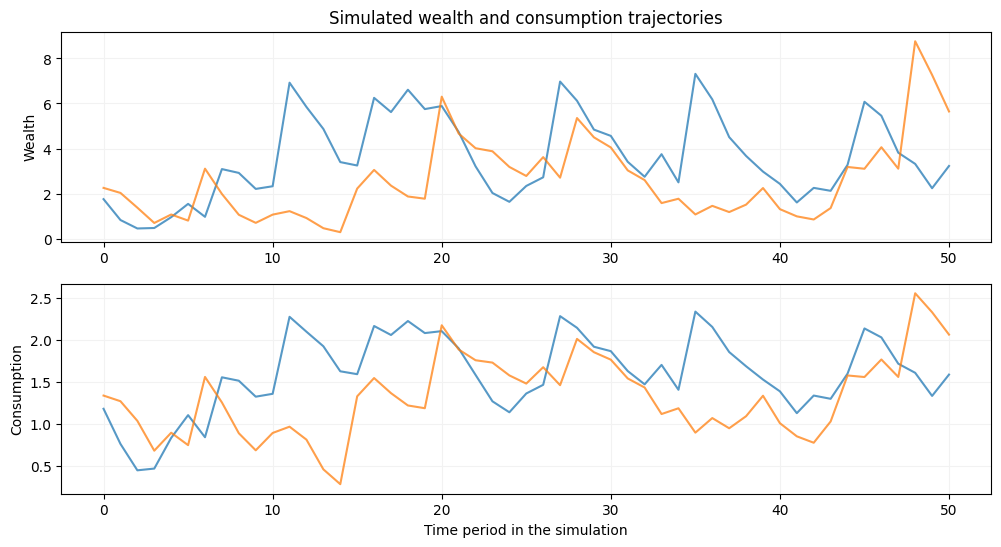
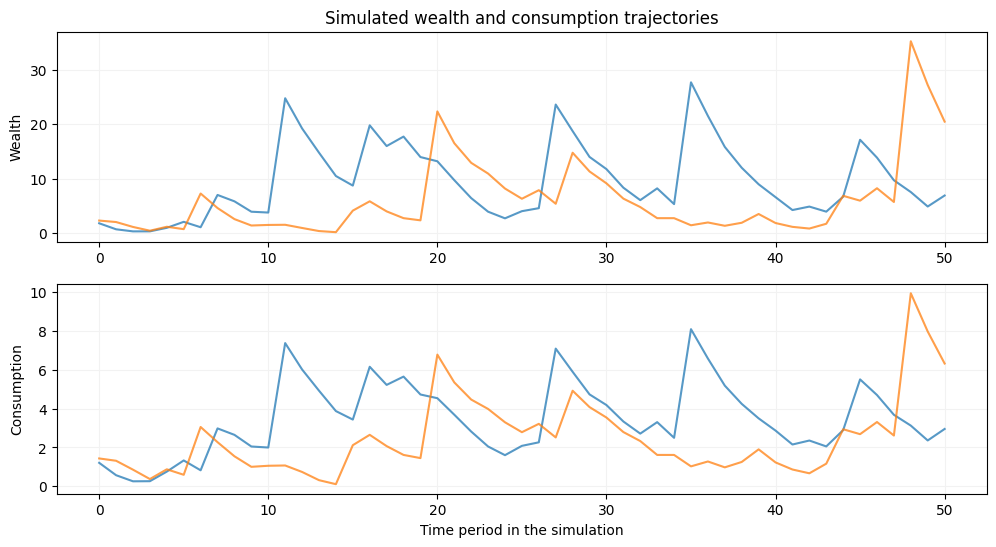
# two stochastic models with different income variance
m1 = deaton(beta=0.9,R=1.05,ngrid=100,nchgrid=250,sigma=0.5)
m2 = deaton(beta=0.9,R=1.05,ngrid=100,nchgrid=250,sigma=0.85)
m1.solve_egm(tol=1e-10)
m2.solve_egm(tol=1e-10)
init_wealth, T = [1.75,2.25], 50
m1.simulator(init_wealth=init_wealth,T=T,seed=2020)
m2.simulator(init_wealth=init_wealth,T=T,seed=2020)
plt.show()
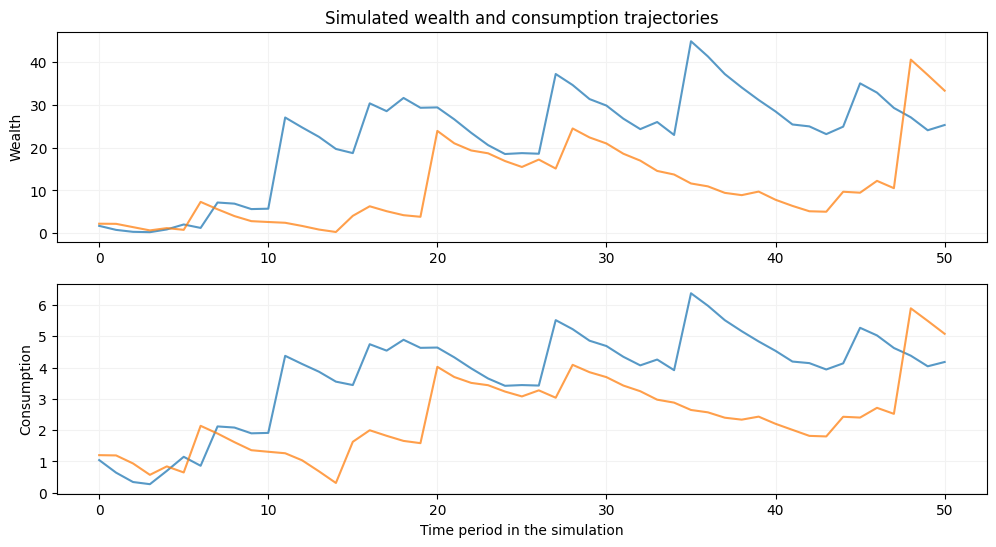
# two stochastic models with different dicount coefficients
m1 = deaton(beta=0.85,R=1.05,ngrid=100,nchgrid=250,sigma=1.5)
m2 = deaton(beta=0.95,R=1.05,ngrid=100,nchgrid=250,sigma=1.5)
m1.solve_egm(tol=1e-10)
m2.solve_egm(tol=1e-10)
init_wealth, T = [1.75,2.25], 50
m1.simulator(init_wealth=init_wealth,T=T,seed=2020)
m2.simulator(init_wealth=init_wealth,T=T,seed=2020)
plt.show()
Method of simulated moments#
we have seen how changing parameters is reflected in changes in the simulated wealth and consumption profiles
imagine we have data on observed consumption or wealth profiles for a sample of people, or even some aggregate data on consumption or wealth
then we can find parameters of the model that would induce the simulated data to reflect the observed profiles, or some descriptive statistics (moments) of these profiles
Simulated moments#
The idea of directly matching the moments from the model to the observed ones leads to the method of moments estimator
Method of moments: # of parameters = # of moments to match, system of equations
Generalized method of moments (GMM): # of parameters < # of moments, minimize the distance between the data moments and theoretical moments
Method of simulated moments (MSM): using simulations to compute the theoretical moments
Definition of MSM estimator#
\( \theta \in \Theta \) is parameter space
\( e(\tilde{x},x|\theta) \) is the row-vector of \( K \) moment conditions
\( W \) is the \( K \times K \) weighting matrix
\( x \) and \( \tilde{x} \) is observed and simulated data
Moments and moment conditions#
\( m^k(\cdot) \) is the \( k \)-th moment generating function
\( m^k(x) \) are empirical moments (computed from the observed data)
\( m^k(\tilde{x}|\theta) \) are the simulated moments (computed from the simulated data using parameter values \( \theta \))
Theory of MSM#
📖 McFadden [1989] “A method of simulated moments for estimation of discrete response models without numerical integration”, Econometrica
📖 Pakes and Pollard [1989] “Simulation and the Asymptotics of Optimization Estimators”, Econometrica
📖 Lee and Ingram [1991] “Simulation estimation of time-series models”, Journal of Econometrics
📖 Duffie and Singleton [1993] “Simulated moments estimation of Markov models of asset”, Econometrica
Statistical properties of MSM estimator#
\( \hat{\theta}_{MSM}(W) \) is consistent with any weighting matrix \( W \)
\( \hat{\theta}_{MSM}(W) \) is asymptotically normal \( \hat{\theta}_{MSM}(W) \sim N(0,\Sigma) \)
Variance-covariance matrix of the estimate#
\( W \) is weighting matrix
\( D = \partial e(\tilde{x},x|\theta) \big/ \partial \theta \) is the Jacobian matrix of moment conditions, computed at consistent estimate \( \theta \)
\( S \) is variance-covariance matrix of the moment conditions \( e(\tilde{x},x|\theta) \)
\( \hat{S} \) is estimate of \( S \), usually computed using simulations as well
\( \tau \) is the ratio of the simulated to empirical samples sizes
Optimal weighting matrix#
the asymptotic variance of the estimates is minimized when the weighting matrix is given by the inverse of the variance-covariance matrix of the moment conditions (at true value of the parameter)
the estimate of the variance-covariance matrix of the MSM estimate then becomes
weighting matrix can be estimated using the simulated analog
Weighting matrix in practice#
identity = in the first step of multi-step MSM estimations
diagonal weighting matrix, ignoring the covariances
manually chosen weights, i.e. to bring all the moments to the same scale
using sample variance to downgrade poorly measured empirical moments
estimated from the moment conditions based on first step consistent estimate
iteratively updated weighting using multi-step estimating procedure
Newey-West robust estimate of weighting matrix
additional model-specific adjustments
Many ways to skin a cat
Choice of moments#
crucial part for MSM estimation = being able to minimize the MSM criterion
more art than science
understanding how the model works = understanding what variation is induced in simulated data when parameters change
selected for estimation \( K \) moments should adequately represent this variation
Practical advantages of MSM#
not data hungry (may match aggregated moments)
allows to combine different sources of data
does not rely on the distributional assumptions as much as MLE
but lacks in efficiency, so standard errors are larger than MLE
weighting matrix is often simplified in practice due to small sample bias
Widely used method in applied research!
Example of EGM with MSM application in structural econometrics
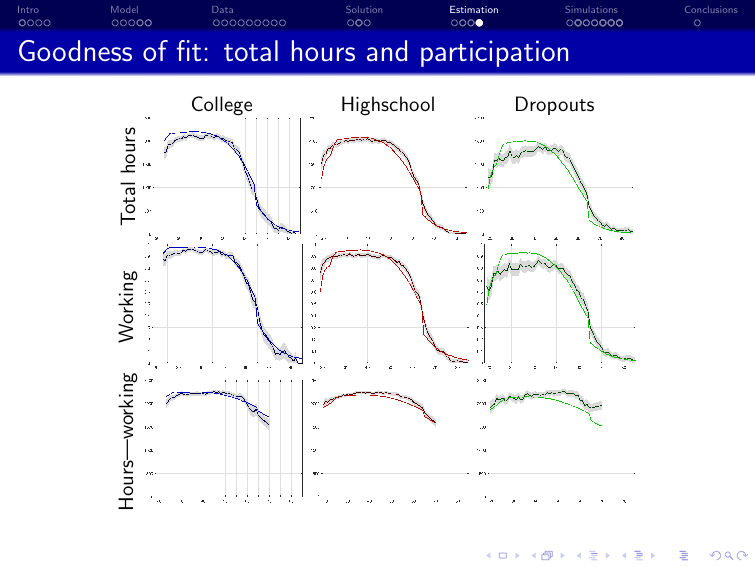
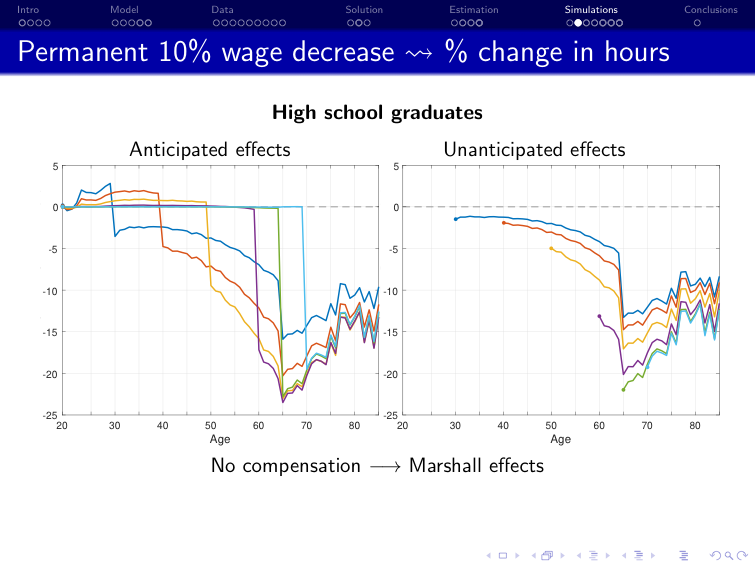
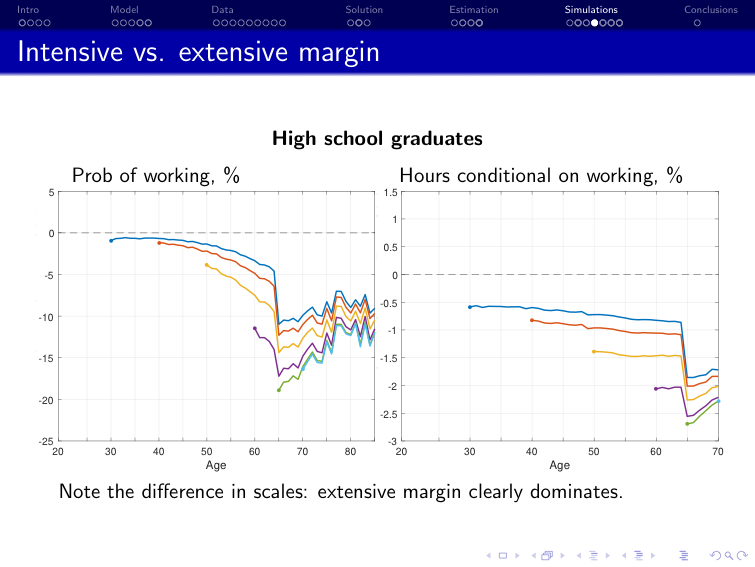
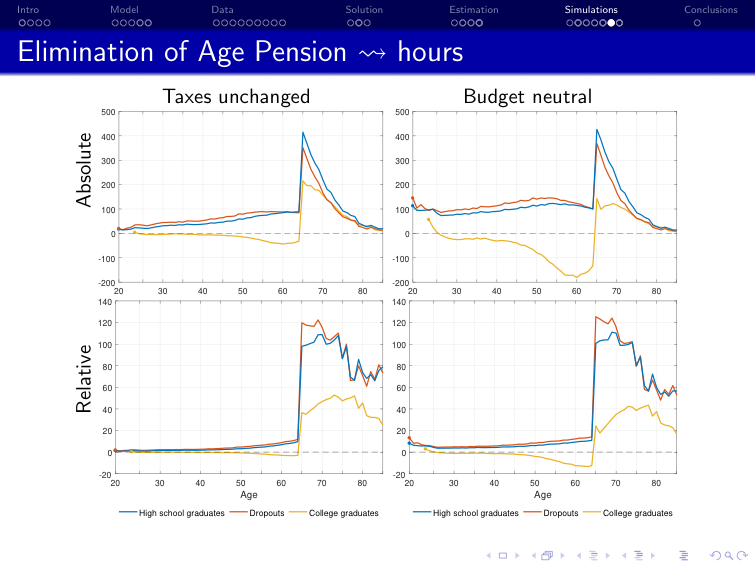
Iskhakov and Keane [2021] “Effects of taxes and safety net pensions on life-cycle labor supply, savings and human capital: The case of Australia”, Journal of Econometrics
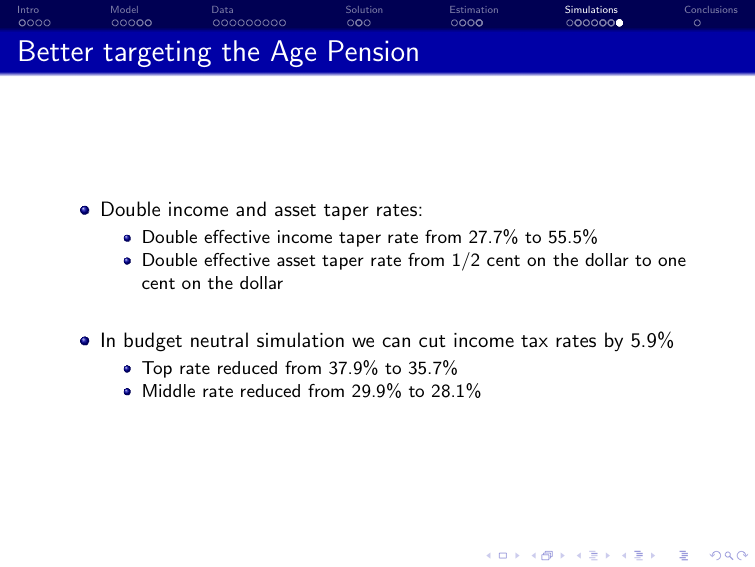
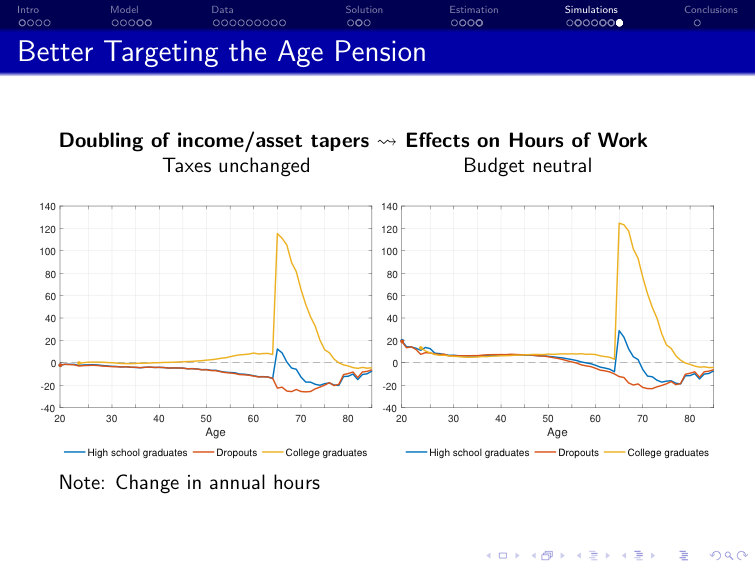
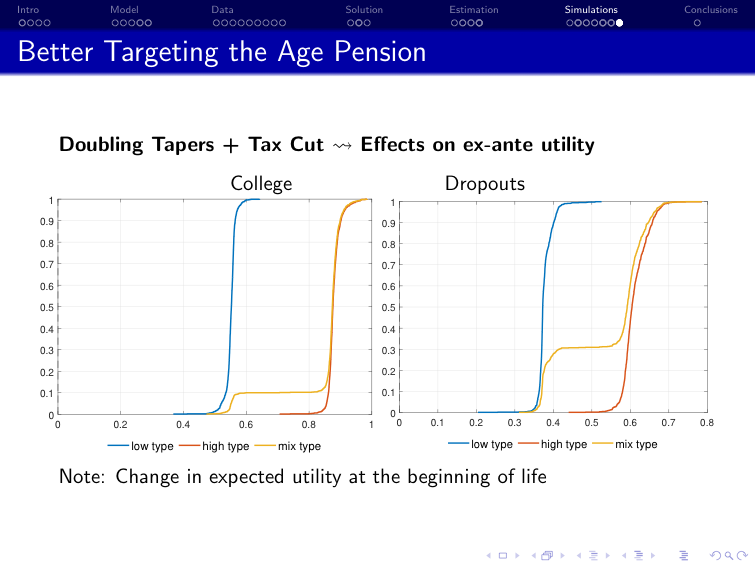
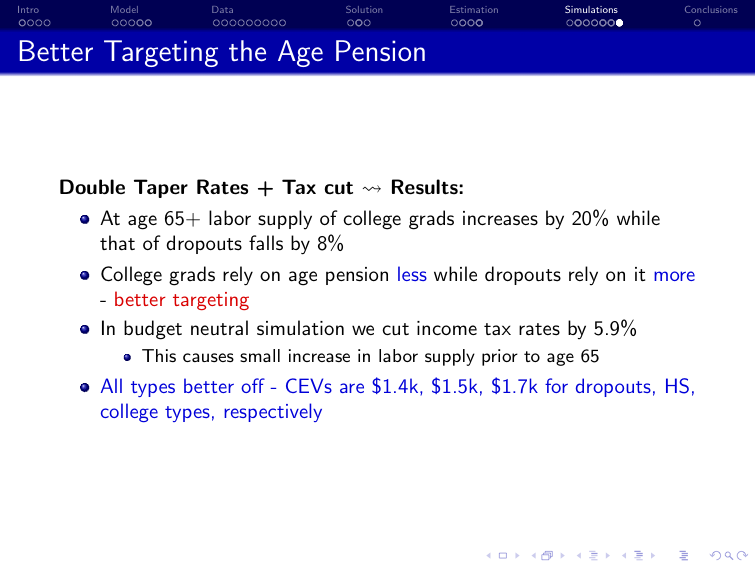
Policy: retargeting of the pension system in Australia
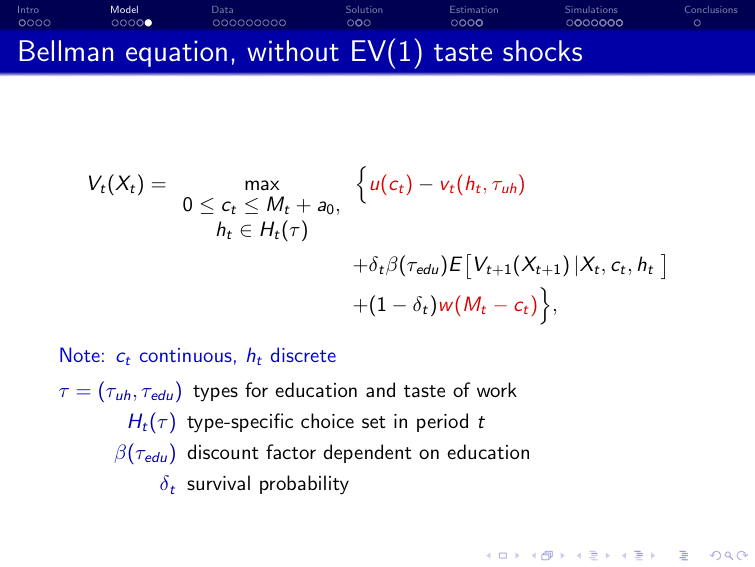
Structural model: dynamic discrete choice model of labor supply, savings, and human capital
Equilibrium: none, partial equilibrium analysis with single decision maker (household)
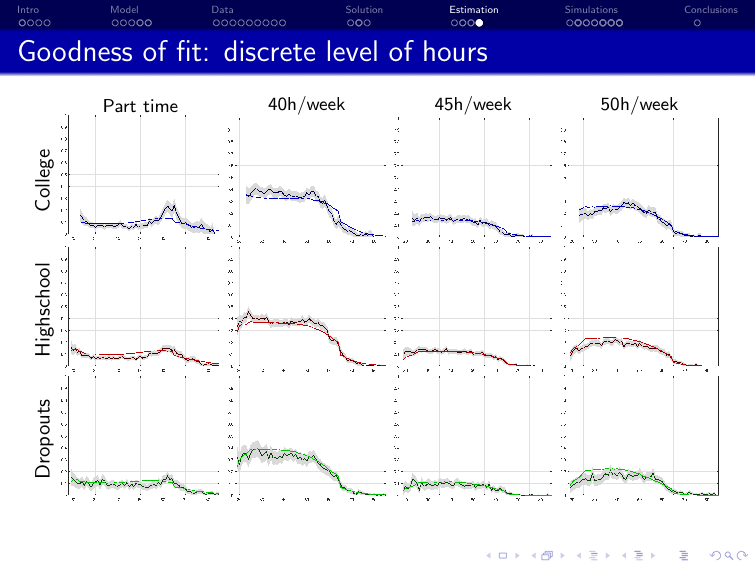
Estimation: method of simulated moments using Australian survey data on labor supply and income (HILDA)

References and Additional Resources
📖 Iskhakov and Keane [2021] “Effects of taxes and safety net pensions on life-cycle labor supply, savings and human capital: The case of Australia”, Journal of Econometrics
📖 Adda and Cooper [2023] “Dynamic Economics” pp. 87-89
📖 McFadden [1989] “A Method of Simulated Moments for Estimation of Discrete Response Models Without Numerical Integration”, Econometrica
Youtube video lecture on MSM by Dean Corbae at DSE2024 summer school at the University of Wisconsin Madison https://youtu.be/61KXTkxZb3o?si=TGgQofH069u-7r0G
Notebook by Richard W Evans on MSM https://notes.quantecon.org/submission/5b3db2ceb9eab00015b89f93