
📖 Introduction to structural estimation#
⏱ | words
Definition
Structural estimation refers to econometric methods that estimate parameters of economic models derived from economic theory, often involving optimization behavior by agents.
Historical overview#
Stage 1: Early Foundations (1930s–1950s)#
Hurwicz, Marschak, Haavelmo, Koopmans, Cowles Commission
Key contributions:
Introduced structural vs reduced form distinction.
Formalized simultaneous equations, endogeneity, identification.
Haavelmo (1944): probability approach to econometrics → modern estimation foundations.
Marschak: structure needed for policy analysis.
Hurwicz: identification theory (order/rank conditions).
Legacy: SEM becomes the dominant approach to causal inference in economics.
Stage 2: The Lucas Critique and Microfoundations (1970s)#
Robert Lucas and the Rational Expectations revolution
Key points:
Structural parameters must be policy invariant.
Ad hoc SEM (with “behavioral equations”) fail under policy changes.
Led to microfounded models derived from optimization and equilibrium conditions.
Birth of DSGE models as dynamic, expectations-driven SEM descendants.
Legacy: SEM concepts survive but become embedded inside microfounded dynamic systems.
Stage 3: Individual-Level Structural Modelling (1980s–1990s)#
Rust (1987): Dynamic discrete choice Hotz–Miller (1993): CCP inversion, reduced-form based identification Berry–Levinsohn–Pakes (1995): Random-coefficients demand estimation
Key innovations:
Microfoundations at the agent level (Bellman equations).
Structural estimation using NFXP and GMM.
Discrete choice demand becomes the IO workhorse.
Legacy: Structural microeconometrics becomes a major field.
Stage 4: Modern Structural IO (1990s–2020s)#
Ericson–Pakes (1995) \(\rightarrow\) dynamic games Aguirregabiria–Mira, Pakes et al., and more recent computational IO
Advances:
Multi-agent dynamic games, heterogeneous firms, entry/exit, investment.
GMM, simulation, and high-dimensional methods.
Close integration with industrial organization and antitrust practice.
Legacy: Modern IO is a fully microfounded, dynamic descendant of SEM.
From Classical SEM to Modern Structural Econometrics
          +----------------------+
          |  Classical SEM       |
          |  (Haavelmo–Marschak) |
          +-----------+----------+
                      |
                      | Microfoundations + Dynamics
                      v
          +----------------------+
          |   DSGE Models        |
          | (Dynamic SEM with    |
          |  expectations & shocks)
          +-----------+----------+
                      |
                      | Structural decision-making
                      v
          +-----------------------+
          | Dynamic Discrete      |
          | Choice Models (Rust)  |
          | Bellman eqns = system |
          +-----------+-----------+
                      |
                      | Strategic interaction + heterogeneity
                      v
          +-----------------------+
          | Structural IO         |
          | (BLP, Ericson–Pakes)  |
          | Demand + Supply as    |
          | equilibrium systems   |
          +-----------------------+
Modern structural econometric models—DSGE, dynamic discrete choice, and structural IO—are dynamic, microfounded generalizations of classical simultaneous equations models (SEM).
Structural & reduced form econometrics#
Aspect |
Structural Econometrics |
Reduced Form Econometrics |
|---|---|---|
Definition |
Estimation of parameters of economic models derived from theory |
Estimation of relationships directly from the data |
Purpose |
Policy analysis, counterfactuals, understanding theoretical mechanisms |
Prediction, local causal inference |
Model |
Based on economic theory, optimization behavior |
Statistical relationships without explicit economic model |
Assumptions |
About details of economic behavior |
About statistical properties of data |
Identification |
Exclusion restrictions, instruments, functional form |
Often relies on natural experiments, IV, regression discontinuity |
Estimation Methods |
MLE, GMM, simulated methods |
OLS, IV, matching, regression discontinuity |
Data Requirements |
Often requires detailed microdata |
Generally less detailed or aggregate data |
Applications |
Structural models of demand, dynamic programming, games |
Reduced form impact evaluations, treatment effects |
Structural econometrics focuses on estimating parameters of economic models derived from theory, allowing for counterfactual analysis and policy simulations.
Reduced form econometrics focuses on estimating relationships directly from data without explicit reference to underlying economic models, often used for prediction or causal inference without structural interpretation.
Definition
Structural modeling is disciplined abstraction for counterfactual analysis.
Questions for discussion/reflection:
How can a complicated new and unique policy be evaluated without a model?
Should not model parameters be determined by the population under consideration?
Can a model be useful without being realistic? Are lab rats realistic representation of humans?
What does “realism” mean? Not accepting perceived conventionality?
Should not research challenge the conventionality by definition?
Why Structural Econometrics?#
Internal Consistency#
Rational agents facing constraints
Explicit uncertainty as probability distribution
Well-defined equilibrium concepts (competative, Nash, etc)
Explicit data-generating processes
Estimation grounded in LLN and CLT
Elegance and Transparency#
Steps can be independently verified
Limited discretion (though numerical implementation still may be subject to issues)
Causality#
A model-based concept of causality
Clear and explicit assumptions
Counterfactuals#
Generated by the model
Valid only within the maintained structure
Require external validity assumptions
Components of structural estimation project#
Economic model derived from economic theory
Microfoundations: optimizing agents (consumers, firms)
With bounded rationality and behavioral extensions
Potentially dynamic decision-making: intertemporal choices
Equilibrium conditions or partial equilibrium keeping certain things fixed
Heterogeneity of agents: observed and unobserved differences
Strategic interactions (games) or infinitely small agents (aggregate market states)
Data generated/described by the economic model
Cross-sectional, time series, or panel data
Individual-level or aggregate-level observations
Potentially censored, truncated, or missing data
Preliminary data analysis
Data cleaning and preparation
Descriptive statistics
Visualization
Reduced form estimation to reduce dimensionality
Feed back into the economic model development
Estimation method to recover structural parameters
Maximum likelihood (full information or limited information)
Generalized method of moments (GMM)
Simulated methods (e.g., simulated maximum likelihood, method of simulated moments)
Bayesian methods
Identification strategy
Exclusion restrictions: variables that affect some equations but not others
Functional form assumptions: parametric or semi-parametric structures
Instruments for endogenous variables (BLP)
Policy invariance assumptions
Counterfactual simulations
Use estimated structural parameters to simulate outcomes under different policies or scenarios
Estimated model is a synthetic laboratory, simulated world for policy analysis
Evaluate welfare effects, market outcomes, or behavioral responses
Conduct policy analysis based on the structural model
Prototype Dynamic Discrete Choice Model#
Choices#
Periods: \(t = 1, \dots, T\), possibly \(T = \infty\)
Actions: \(j = 1, \dots, J\)
Indicators: \(d_{jt} \in \{0,1\}\)
Mutual exclusivity is not restrictive: combinations can be redefined as distinct actions.
States and Transitions#
Let the state be \(z_t \in \mathcal{Z}\). This is all the information that is relevant for the decision at time \(t\).
Transition probabilities when action \(j\) is chosen at period \(t\)
State spaces may be large but are often sparse.
Preferences and Expected Utility#
Flow/current/instantaneous utility at time period \(t\) when action \(j\) is chosen
Discount factor
Expected utility
Value Functions and Bellman Equation#
Define the optimal policy \(d_t^\star(z_t)\) as vector of zeros and one indicating the most desirable action.
Value function = conditioning on optimal behavior in all future periods = maximal attainable expected utility from period
Bellman equation:
We will later see how Bellman equation can be solved and value functions computed numerically
Define choice-specific value:
By definition the optimal choice is:
Why Unobserved Heterogeneity Is Needed#
If agents with identical observed states are observed in the data to choose differently
The model implies indifference between actions
All actions appear optimal
The model loses empirical content!
Therefore fully observed heterogeneity is useless for data analysis.
Unobserved Heterogeneity Framework#
Decompose the state:
\(x_t\): observed by both agents and econometrician
\(e_t\): unobserved by econometrician, but observed by agents
The objective becomes predicting choice probabilities, not individual choices.
Data Generating Process#
Observed data are states and corresponding choices:
with the individual observations given by
Likelihood integrates out unobservables:
Huge multidimensional integral in general case!
We will see how Rust assumptions simplify this drastically
Maximum Likelihood Estimation#
Let \(\theta\) index utilities, transitions, and \(\beta\).
Early applications include Miller (1984) and Wolpin (1984).
Other estimation approaches:
Two-step methods based on conditional choice probabilities estimated directly from the data (CCP methods) (Hotz–Miller, Aguirregabiria–Mira)
GMM
Method of simulated moments (MSM)
Calibration (no standard errors)
Multiple decision makers \(\rightarrow\) equilibrium models#
Macro style models with aggregate states#
Infinitely many agents
Individual actions do not affect aggregate states
Aggregate states affect individual payoffs and transitions
Aggregate states evolve according collective behavior of all of the agents
Dynamic Markov Games#
Finite number of agents
Individual actions affect payoffs and transitions of all other agents
Joint individual actions affect payoffs and transitions
Equilibrium defined by mutual best responses
Nash
Bayesian Nash
Markov Perfect Equilibrium (MPE)
Oblivious equilibrium, etc.
Example of policy analysis based on structural estimation
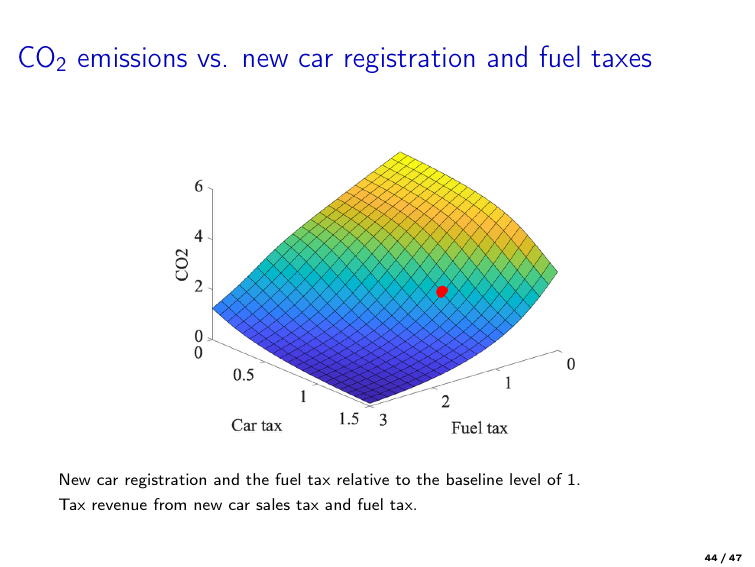
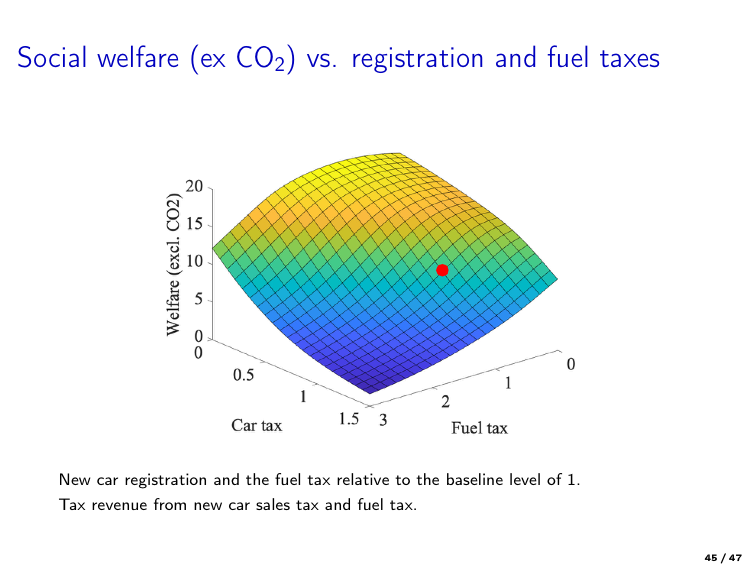
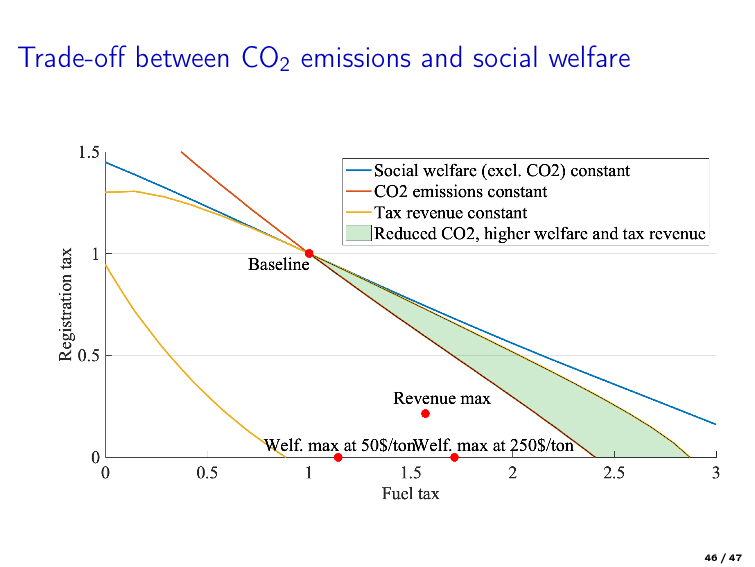
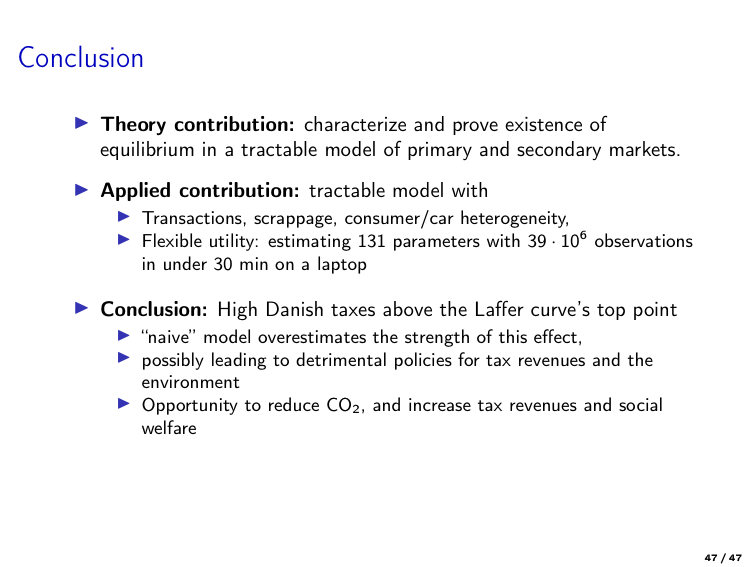
Gillingham et al. [2022] “Equilibrium Trade in Automobiles,” Journal of Political Economy
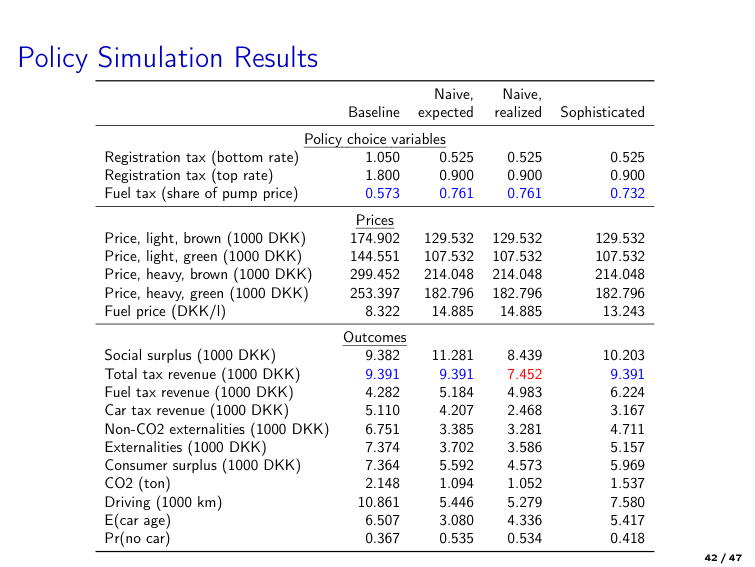
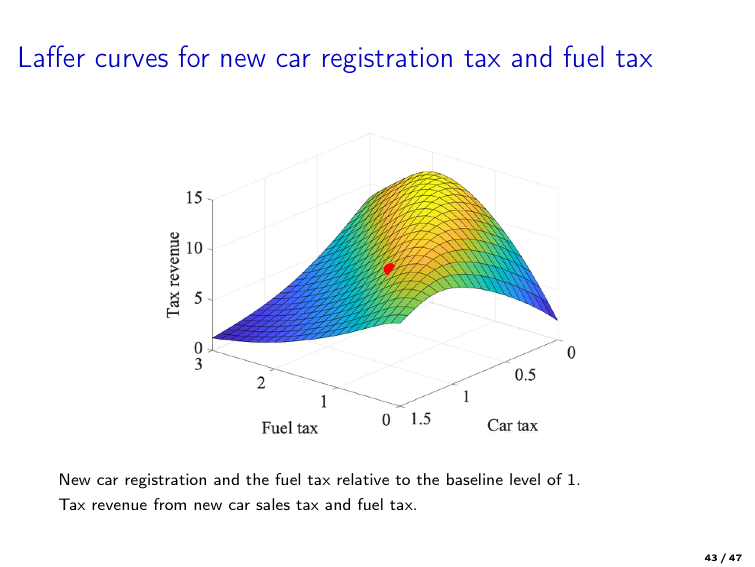
Policy: restructuring of car registration and fuel taxes in Denmark
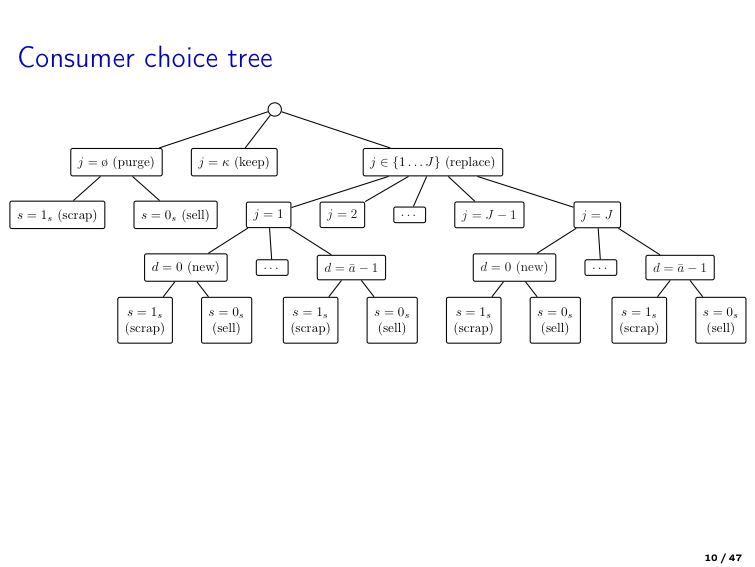
Structural model: dynamic discrete choice model of car ownership and usage
Equilibrium: used car prices adjust to balance supply and demand in the secondary market
Estimation: MLE using Danish register data on car ownership and usage

References and Additional Resources
📖 “Economic Theory and Measurement: A Twenty Year Research Report, 1932–1952” report by Cowles Commission, University of Chicago, 1952
Download pdf📖 Keane [2010] “Structural vs. atheoretic approaches to econometrics”, Journal of Econometrics
📖 Wolpin [2013] “The Limits of Inference without Theory”, The MIT Press
📖 Rust [2014] “The Limits of Inference Theory: A Review of Wolpin (2013)”, Journal of Economic Literature
📖 Sargent [2024] “Critique and consequence”, Journal of Monetary Economics 2024
Michael Keane’s lecture on structural estimation at BFI at the University of Chicago https://youtu.be/0hazaPBAYWE