🏛 Topics in Structural Econometrics#
Short course at the University of Oslo, January 2026
This course provides a graduate-level introduction to the structural estimation static and dynamic disrete choice models. It covers the foundations of random utility models, maximum likelihood estimation, dynamic programming, and various estimation methods, including Nested Fixed Point Algorithm (NFXP), two-step methods based on conditional choice probabilities (CCP), and Nested Pseudo Likelihood (NPL).
Course page at UiO: ECON9104C
🧑🏫 Instructor#
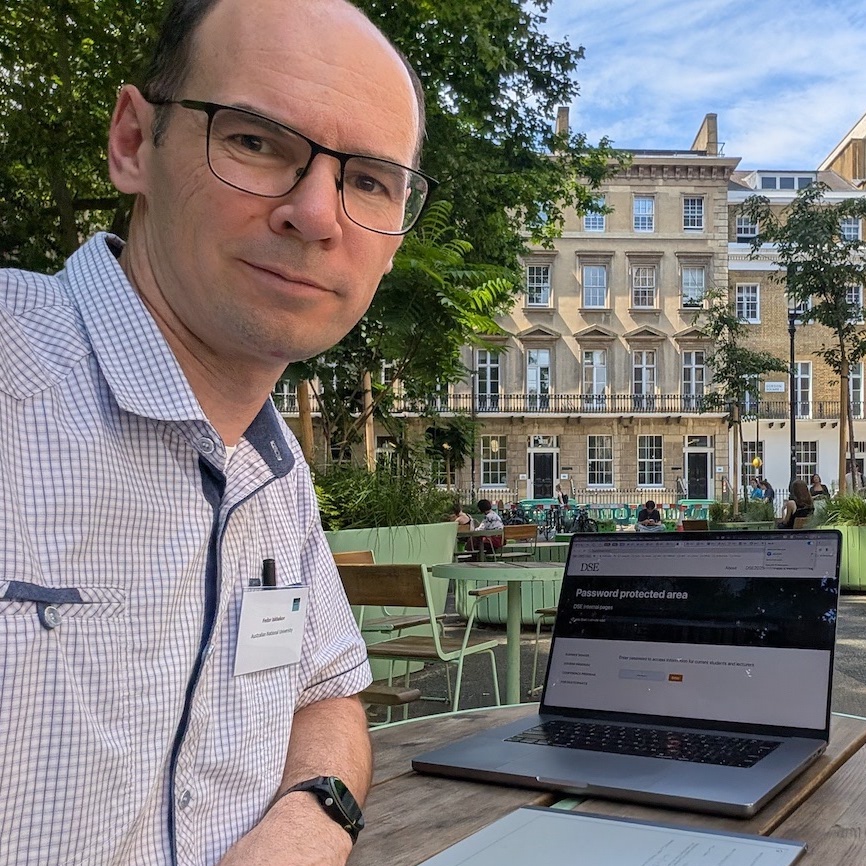
Fedor Iskhakov
Professor of Economics, Australian National University
Email:
fediskhakov@gmail.comWeb: Personal page
📆 Lecture schedule#
Date |
Theory |
Practice |
|---|---|---|
January 12 |
Static random utility models |
Computational setup, Python refresher |
January 13 |
Maximum likelihood estimation |
MLE implementation for logit models |
January 14 |
Dynamic programming |
Implementing various solution methods |
January 15 |
Rust-Zurcher engine replacement model |
Implementing NFXP estimator |
January 16 |
Consumption-savings model |
Endogenous gridpoint method and |
🏡 When and Where#
5 days: approximately 2 hours of theory + 3 hours of practical exercises
Date |
First session |
Second session |
Location |
|---|---|---|---|
Jan 12 Monday |
11.00 – 12.00 |
14.15-17.45 |
Room 1249, Eilert Sundt’s building |
Jan 13 Tuesday |
10.15 – 12.00 |
14.15-17.00 |
Room 101, Harriet Holter’s building |
Jan 14 Wednesday |
10.15 – 12.00 |
14.15-17.00 |
Room 101, Harriet Holter’s building |
Jan 15 Thursday |
10.15 – 12.00 |
14.15-17.00 |
Room 1249, Eilert Sundt’s building |
Jan 16 Friday |
10.15 – 12.00 |
14.15-17.00 |
Room 101, Harriet Holter’s building |
🎓 Exam#
Individually or in a group of two
Set up and solve a problem using tools from the course
Submit a short proposal of what you intend to write about by Friday, January 23rd
Final assessment will be based on video-presentation of the project (10 min max)
The video + project paper + code have to be submitted by Monday, February 28th, 2026
Ideas for projects:#
Implement and estimate a static or dynamic discrete choice model of your interest using real or simulated data. Ideally the following steps should be included:
Theoretical model description
Solver code
Simulator code
Estimator code
Application of the model to the data
Counterfactual simulations of some sort
Project with steps as above using one of the models in the course and labs:
Static random utility model (mixed logit, nested logit)
Extension of Rust-Zurcher bus engine replacement model (additional state variable, specification search for cost functions, etc)
Inventory management model (add simulator and estimator to existing implementation, or also reformulate the solver to account for the symmetry in the policy function we observed in the lab)
Consumption-savings model (extend the model with additional features, i.e. additional state variables to account for agent heterogeneity, etc.)
Location choice model from lab 2 (possibly modify to the model, simulator code, counterfactuals, etc.)
Short proposal#
Should give a brief description of the project you intend to carry out
Should clearly lay out the roadmap of steps you intend to take
Final submission#
Submission should include:
Project document based on the proposal (pdf), does not have to be long
Code developed for the project, ideally well documented and structured (Jupyter notebook, Python files)
Video presentation summarizing what you have done, and describing the main steps and findings
Use Zoom, Loom or any other screen recording software
Make sure your face appears in the video (as overlay or in the introduction)
Upload the video on shared files system or YouTube, and include the link in your submission
Submission should be done via a Pull Request to the course GitHub repository (similar to student survey you did in the first day).
Please, submit on time. Grades for late submissions without appropriate justification will be penalized.
Grading#
Pass / Fail
The main criterion is to verify your understanding of the steps of a typical structural estimation project
I will provide grades and some feedback within two weeks after the submission deadline (above)
🫶 Feedback and student evaluation#
Please, share your feedback anonymously via this Suggestion Box
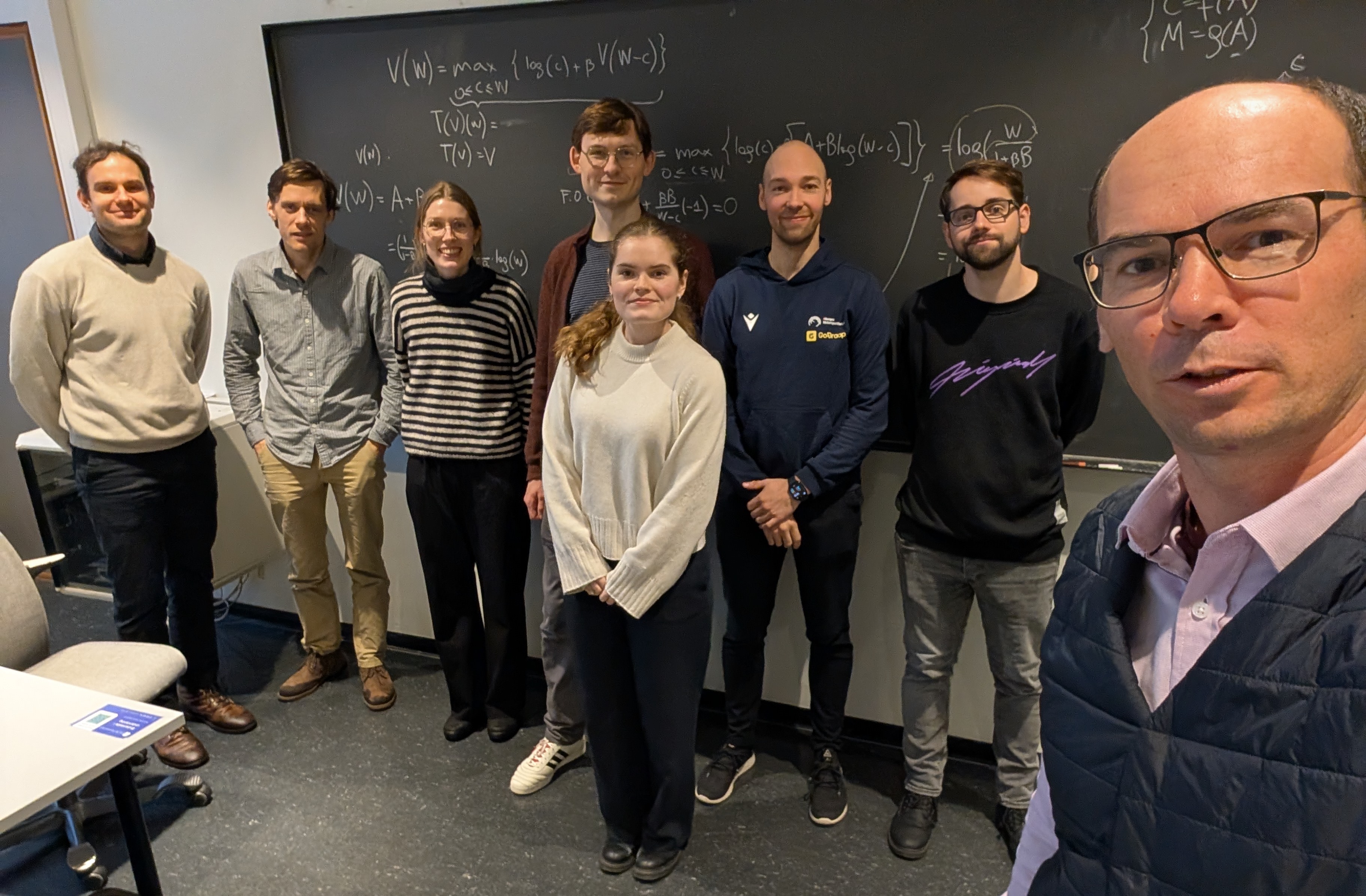
📷 Class photo#